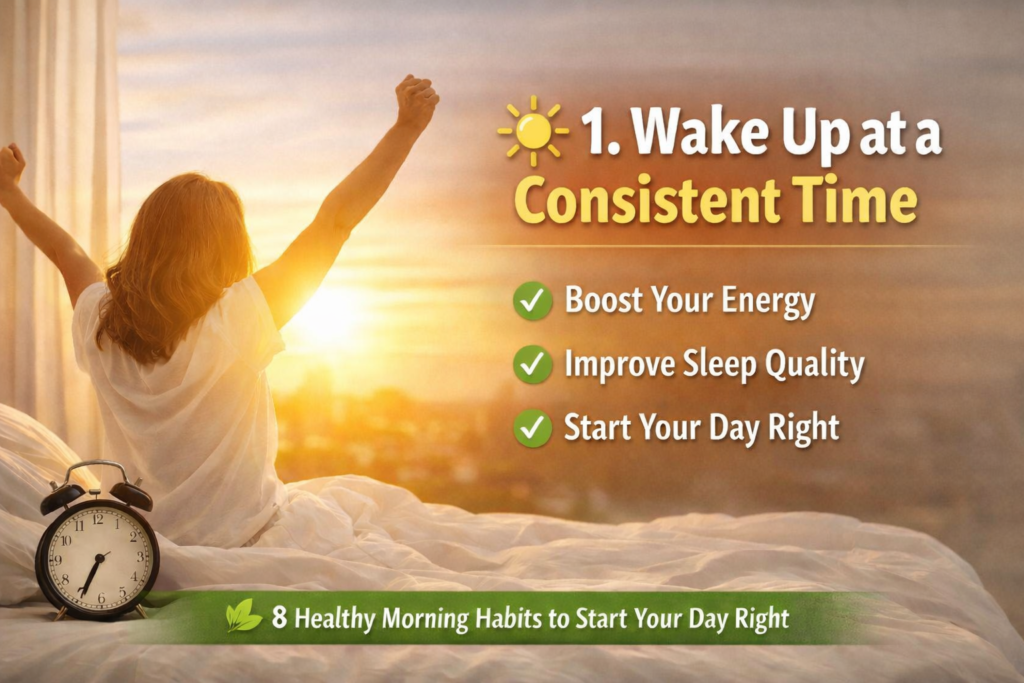
8 Healthy Morning Habits to Start Your Day Right (Simple & Effective)

Your morning routine is not just a collection of tasks — it is a signal you send your brain before the rest of the world gets to send its own. Research consistently shows that people with structured morning habits report higher energy, better mental health, improved productivity, and even healthier body weight. The good news? You do not need to wake up at 4am, own a standing desk, or drink anything that looks like pond water.

These 8 science-backed healthy morning habits are simple, realistic, and proven to work — for adults, students, parents, and everyone in between.


Why Your Morning Routine Shapes Your Entire Day

The first 60 minutes after waking are among the most influential minutes of your day. Cortisol — often called the “alertness hormone” — naturally peaks in the morning. Your brain is receptive, your willpower reserves are full, and the decisions you make now set the trajectory for everything that follows.

A landmark 40-year study by Harvard researchers published in the journal Circulation found that people who consistently maintained healthy daily habits — including regular movement and a nutritious diet — reduced their risk of premature death from cancer and cardiovascular disease by up to 82%. Habits matter enormously. And morning is where habits begin.


What Is the Healthiest Way to Start Your Morning?

The healthiest way to start your morning is to hydrate immediately, get natural light, move your body, and eat a protein-rich breakfast. Those four steps alone can dramatically shift your energy, focus, and mood — without any supplements or complicated routines.

Everything beyond those basics — journaling, meditation, cold showers — builds on top of this foundation. Start simple. Add complexity only once the basics feel automatic.


Habit 1: Drink Water Before You Touch Your Phone

Your body loses water overnight through breathing, sweating, and normal cell function. Drinking 250–500ml of water first thing rehydrates your cells, jumpstarts your metabolism, and clears the mental fog that clings to you after sleep.

According to the U.S. Geological Survey, the human body is approximately 60% water by weight. A 2012 study in The Journal of Nutrition found that even mild dehydration — as little as 1.36% water loss — was enough to impair mood, reduce concentration, and trigger headaches in healthy young women, even at rest. Dehydration does not have to be dramatic to affect how your brain works.

You do not need lemon, ginger, or apple cider vinegar to make morning hydration effective. A plain glass of water does the job. If you want to explore the benefits of infused water further, our guide on warm water with lemon and ginger covers what the research actually says.

💡 Factual Insight: The National Academy of Medicine recommends a total daily water intake of 3.7 litres for men and 2.7 litres for women — including water from food sources such as fruits and vegetables. For more on daily hydration targets, read our detailed guide on how many litres of water you should drink daily.


Habit 2: Get Natural Light Within the First Hour of Waking

Exposure to natural morning light within 30–60 minutes of waking signals your brain to suppress melatonin (the sleep hormone) and boost serotonin — making you feel alert, calm, and focused rather than sluggish.

Your body runs on a circadian rhythm — a 24-hour internal clock that regulates sleep, hunger, mood, and energy. Morning light is the primary reset signal for this clock. Without it, your internal timing drifts, which can lead to poor sleep at night, low energy during the day, and mood instability over time.

You do not need to stare into the sun (please do not). Step outside for 5–10 minutes while you drink your morning water, or sit next to a bright window. Even on overcast days, outdoor light is significantly brighter than indoor lighting — enough to trigger the same circadian signal.

💡 Factual Insight: The National Sleep Foundation identifies morning light exposure as one of the most effective, evidence-based strategies for regulating the sleep-wake cycle and improving sleep quality at night — with no cost and no side effects.


Habit 3: Move Your Body ž Even for Just 10 Minutes

You do not need a 60-minute gym session to get the benefits of morning exercise. Even a 10-minute walk, a short yoga flow, or a few sets of bodyweight exercises significantly reduces stress hormones, improves blood flow to the brain, and lifts your mood for hours afterward.

A study published in JAMA Psychiatry by Harvard researchers found that running for just 15 minutes a day — or walking for one hour — was associated with a 26% lower risk of developing major depression. That is a significant outcome from a surprisingly small investment of time.

Morning exercise also matters for timing. A 2019 study in the British Journal of Sports Medicine found that people who exercised at 7am showed better attention, faster decision-making, and improved visual memory throughout the day — compared to those who exercised at midday or in the evening.

💡 Factual Insight: The CDC recommends that adults get at least 150 minutes of moderate-intensity aerobic activity per week — just over 21 minutes per day. Morning is the most reliable window to get it done, because it happens before the day’s interruptions take over.


Habit 4: Eat a Breakfast That Actually Fuels You

A protein-rich breakfast keeps blood sugar stable, reduces mid-morning cravings, and gives your brain the glucose it needs to function properly. Skipping breakfast might feel like discipline — but your brain usually disagrees by 10am.

When you skip breakfast, your blood sugar drops and your body interprets this as mild stress. The result: irritability, brain fog, and a strong pull toward high-sugar, high-calorie foods later in the day. A study published in The American Journal of Clinical Nutrition found that participants who ate a high-protein breakfast consumed significantly fewer total calories throughout the day compared to those who ate a low-protein breakfast or skipped it entirely.

The Cleveland Clinic recommends building a breakfast around protein (eggs, Greek yogurt, nuts, or legumes), complex carbohydrates (oats, whole grain toast), and healthy fats (avocado, nut butter). Skip the sugary cereals and packaged juices — they spike your blood sugar and drop it again within an hour.

💡 Factual Insight — Healthy Morning Routine for Weight Loss: For people aiming to manage their weight, protein at breakfast is one of the most researched and supported strategies. High-protein breakfasts increase satiety hormones (like GLP-1 and PYY) and reduce ghrelin — the hunger hormone — keeping appetite in check for longer after the meal.


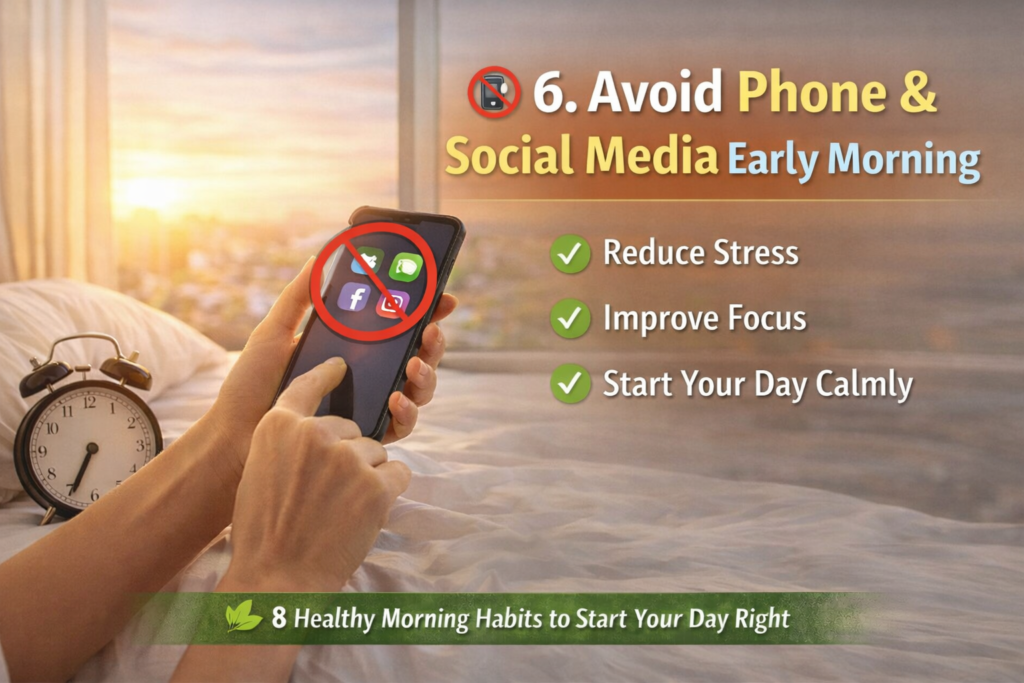
Habit 5: Keep Your Phone Off for the First 30 Minutes

Checking your phone first thing floods your brain with notifications, news, and other people’s priorities before your own mind is fully awake. It spikes cortisol and sets a reactive rather than intentional tone for everything that follows.

Your brain’s prefrontal cortex — the part responsible for planning, decision-making, and focused thinking — is still warming up in the first 20–30 minutes after waking. This window is called “sleep inertia,” and bombarding it with emails and social media is like asking someone to sprint before they have stretched.

A report from the American Psychological Association found that constant connectivity — especially checking messages and social media immediately after waking — was associated with meaningfully higher stress levels across all age groups. The fix is straightforward: charge your phone in another room and reach for your water glass first.

➠️ Watch Out: Research from the University of Texas at Austin found that even having your phone visible on a desk — face-down and silent — reduces available cognitive capacity. Your brain devotes background resources to resisting the urge to check it. Put it in another room. Out of sight genuinely means better focus.


Habit 6: Write Down Three Things You Are Grateful For

Gratitude journaling takes under two minutes and consistently shows up in research as one of the most cost-effective interventions for improving mood, reducing anxiety, and reframing the brain’s default focus away from problems and toward what is going well.

This is not wishful thinking or positive affirmations for their own sake. Robert Emmons, a leading gratitude researcher at UC Davis, conducted several studies showing that people who regularly wrote about things they were grateful for reported fewer physical complaints, felt more energetic, and experienced more positive emotions compared to those who did not.

The key is specificity. Instead of writing “I’m grateful for my family,” try “I’m grateful that my daughter made me laugh before I left the house.” Specific, vivid gratitude activates more neural pathways and has a stronger emotional impact than vague statements.

💡 Factual Insight: A 2003 study published in the Journal of Personality and Social Psychology (Emmons & McCullough) found that participants who wrote gratitude letters reported significantly higher happiness scores and lower depression levels — effects that persisted for up to one month after the study ended.


Habit 7: Splash Cold Water on Your Face (or Take a Short Cold Rinse)

Cold water on your face triggers what is called the “diving reflex” — a natural physiological response that briefly slows your heart rate and increases blood flow to the brain, producing a reliable spike in alertness and mental clarity.

A full cold shower is not required to get the benefit. Thirty seconds of cold water on your face produces a meaningful alertness boost. If you prefer a full cold shower, a study published in PLOS One found that participants who took cold showers for 30–90 seconds reported 29% fewer sick days compared to those who took exclusively warm showers. That is a meaningful result from a very small daily habit.

Beyond the physiological benefits, this habit creates a clear sensory “start signal” for your body — a physical cue that says the quiet morning time is over and the day has begun. Routine anchors like this are important for habit formation and daily structure. This ties directly into the broader advice from our article on 10 daily habits for a healthier life.


Habit 8: Write Down Your Top Three Priorities Before You Open Your Inbox

Planning your top three tasks for the day — before your inbox or calendar opens — gives your brain a clear direction and makes it far less likely to drift into low-priority busywork throughout the day.

This is often called a “Most Important Tasks” (MIT) list. The idea is simple: if you only finished three things today, what are the three that would make the biggest difference? Writing these down — not just thinking about them — commits them to working memory and sets a clear intention for the day.

A study conducted by Dr. Gail Matthews at Dominican University of California found that people who wrote down their goals were 42% more likely to achieve them compared to those who only thought about their goals. Writing adds accountability — even if the only person reading the list is you.

💡 Factual Insight: This habit pairs naturally with gratitude journaling (Habit 6). Combined, both habits take under five minutes and give you emotional grounding (gratitude) plus practical direction (priorities) — two things that almost every productivity framework in the last 30 years has pointed to as essential.


What Is the 5-5-5-30 Morning Routine?

The 5-5-5-30 morning routine is a structured morning routine list designed for people who want a simple, repeatable framework without overcomplicating things. Here is what it involves:

  • 5 minutes of light stretching to loosen the body after sleep
  • 5 minutes of meditation, deep breathing, or quiet sitting
  • 5 minutes of journaling or gratitude writing
  • 30 minutes of moderate physical activity — walking, cycling, or a home workout

Total time: 45 minutes. This framework covers movement, mindfulness, and intention-setting — all three pillars of a productive morning — without requiring expensive equipment or professional training. It is a practical starting point for anyone building a healthy morning routine for adults who lead busy lives.


What Are the 6 Miracle Morning Habits?

The 6 Miracle Morning habits come from Hal Elrod’s bestselling book The Miracle Morning. The acronym is SAVERS — and each letter represents one habit:

  • S — Silence: Meditation, prayer, or quiet breathing to calm the nervous system
  • A — Affirmations: Positive self-talk to reinforce beliefs and goals
  • V — Visualisation: Mentally rehearsing your goals and the steps to achieve them
  • E — Exercise: Physical movement to energise the body and mind
  • R — Reading: Personal development reading to grow knowledge and perspective
  • S — Scribing: Journaling to process thoughts, reflect, and track progress

Many people begin with a 6-minute version — one minute per habit — and gradually expand each element as the routine becomes automatic. The elements with the strongest independent research backing are exercise, journaling, and reading. Affirmations and visualisation are more variable in the evidence base, though some research supports their role in goal-setting and self-efficacy.


What Is the 20/20/20 Morning Routine?

The 20/20/20 morning routine, also associated with Hal Elrod’s framework, breaks the first hour of your morning into three equal 20-minute blocks:

  • 20 minutes of vigorous exercise — to wake the body, boost endorphins, and improve circulation
  • 20 minutes of reflection — meditation, silence, affirmations, or quiet journaling
  • 20 minutes of personal development reading — books, research, or learning in your field

This structured approach works particularly well for students and working professionals who want a morning routine list that feels purposeful and deliberate. The three blocks align with physical health (exercise), mental health (reflection), and intellectual growth (reading) — a fairly comprehensive morning in a single hour.


Quick Reference: All 8 Morning Habits at a Glance

Your Healthy Morning Habits Checklist:

  1. Drink 250–500ml of water before reaching for your phone
  2. Get 5–10 minutes of natural morning light (outdoors or near a window)
  3. Move your body for at least 10 minutes — walk, stretch, or exercise
  4. Eat a protein-rich breakfast (eggs, yogurt, oats with nuts)
  5. Keep your phone off for the first 30 minutes after waking
  6. Write down three specific things you are grateful for
  7. Splash cold water on your face or take a short cold rinse
  8. Write your top three priorities for the day before opening your inbox

Frequently Asked Questions

What is the scientifically best morning routine?

Research across multiple fields consistently points to four core elements: hydration immediately on waking, morning light exposure within the first hour, physical movement of at least 10 minutes, and a protein-rich breakfast. Beyond those, gratitude journaling and avoiding screens for the first 30 minutes have strong psychological and neurological support. No single routine works for every person, but those four foundational steps have the most consistent evidence behind them.

What is the best healthy morning routine for women?

A healthy morning routine for women generally follows the same evidence-based principles as for any adult: hydration, movement, nutrition, and mindfulness. Strength training or resistance exercise in the morning has particular benefits for bone density, which becomes especially important for women as they age. Morning light exposure also plays a role in regulating hormonal cycles. The best routine is the one that fits your schedule and that you can actually stick to — consistency matters far more than perfection.

What are 5 healthy morning habits that anyone can start today?

If you are starting from scratch, pick these five first: (1) drink a glass of water before anything else, (2) get five minutes of morning sunlight, (3) eat breakfast rather than skipping it, (4) move your body for 10 minutes, and (5) write down three priorities before opening your inbox. These five habits cost nothing, take under 45 minutes total, and address hydration, circadian rhythm, nutrition, physical health, and mental focus — the core pillars of a productive morning.

How long does it really take to build a morning habit?

The commonly cited “21 days” figure is a myth. Research by Dr. Phillippa Lally at University College London found that the median time for a new behaviour to become automatic was 66 days — with a range of 18 to 254 days depending on the habit and the person. Simple habits (like drinking water) form faster; more complex ones (like a 30-minute exercise routine) take longer. The key is not perfection — missing a day or two does not reset the process. Just return to the habit the next morning.


The Bottom Line

None of these eight habits require an alarm at 4am, a personal trainer, or a kitchen full of superfoods. They require showing up consistently — most days, not every day. Research from University College London reminds us that the median time to form a new habit is 66 days. Pick one or two habits from this list and focus on those first. Add more when they feel effortless.

The difference between a productive morning and a chaotic one is rarely willpower — it is having a plan before the chaos begins. For more on building lasting healthy routines, see our guide on 10 daily habits for a healthier life and learn how drinking enough water improves your health naturally.

Free Newsletter

Enjoyed this article?

Get practical guides on nutrition, fitness & daily healthy habits delivered to your inbox each week.

No spam, ever. Unsubscribe anytime.

Leave a Comment

Your email address will not be published. Required fields are marked *

Scroll to Top